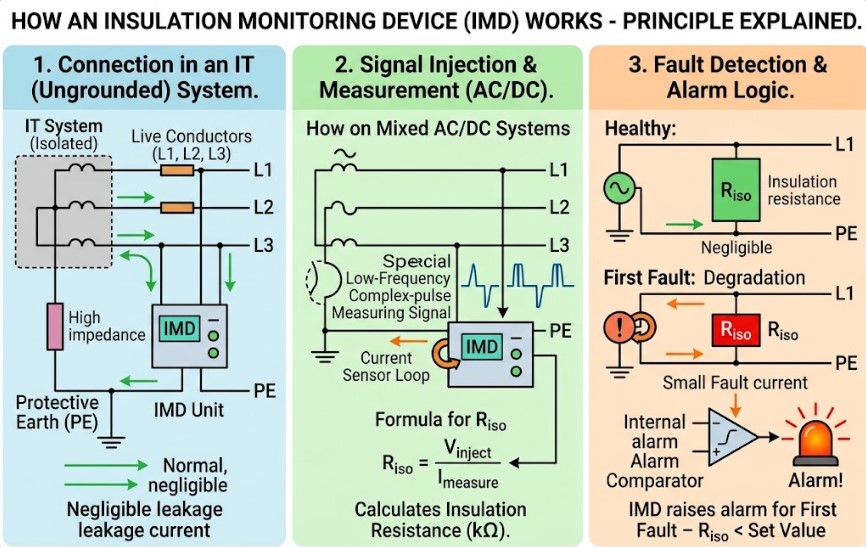
How Does an Insulation Monitoring Device Work? IMD Working Principle Explained
Insulation monitoring helps teams detect degradation before it becomes a safety risk, especially in floating DC and new energy systems.

Gongyuan’s solutions start from your system, not from a product list. Tell us where the risk is, such as a charging pile, a battery cabinet, a PV string or a rail DC bus, and we recommend where to monitor, how to connect the alarm and which insulation monitoring device fits.
1. Risk scenario: Insulation degradation from moisture, connector wear or cable damage in the charging pile and vehicle path.
2. Monitoring approach: Monitor the DC output during charging, with relay alarm to stop or limit the session.
1. Risk scenario: Condensation, coolant leaks or damaged insulation inside battery cabinets on high-voltage platforms.
2. Monitoring approach: Continuous insulation resistance monitoring on the DC bus with early-warning threshold before a hard fault.
1. Risk scenario: Ageing cables, UV, rain and dust reducing insulation on strings and DC bus.
2. Monitoring approach: Monitor the DC side of the inverter or combiner to catch a first fault before it becomes a short circuit.
1. Risk scenario: Vibration, dust and humidity in auxiliary and traction-related floating systems.
2. Monitoring approach: Continuous monitoring with relay alarm to the SCADA or control cabinet.
Before ordering, prepare: system voltage and AC/DC type, single or multi-circuit, alarm threshold needed, communication protocol (relay, RS485/Modbus, CAN), installation environment, certification required (TUV/CE).

Insulation monitoring helps teams detect degradation before it becomes a safety risk, especially in floating DC and new energy systems.

DC insulation detection supports uptime, preventive maintenance, and safer operation in PV, storage, and DC grid projects.
Get model recommendations, technical parameters, certification files, and integration support.