


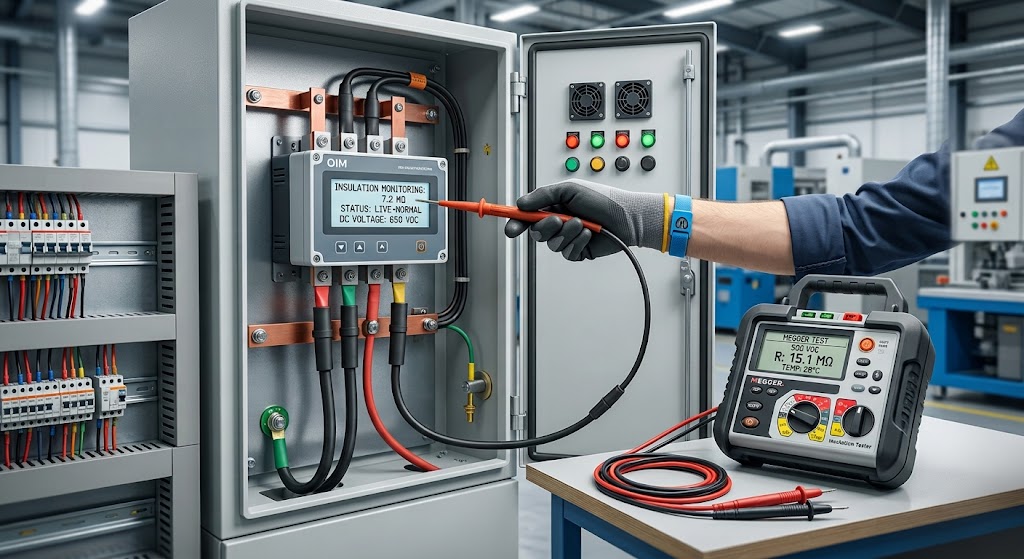
online insulation monitoring measures insulation resistance all the time while the system is live and raises an alarm when the value drops. A megger test measures insulation resistance once while the system is switched off and isolated. It applies a high test voltage that stresses the insulation. In the insulation monitoring vs megger test question the answer is not one or the other. Most DC and AC floating systems need both.
Engineers often ask which one to buy. The better question is which job each one does. A megger gives a verified reading on the day of the test. An online monitor protects the system on every other day of the year. This guide explains how each method works and why their readings rarely match. It also shows when to use each one and how to choose a monitor for your system voltage.
What Is Online Insulation Resistance Monitoring?
Online insulation resistance monitoring is the continuous measurement of insulation resistance between the live conductors of an ungrounded (IT) system and earth while the system is energised. A fixed insulation monitoring device (IMD) does the measuring. When the value falls below a set threshold it triggers an alarm or a relay output.
An IMD injects a small measuring signal between the system and earth. It then calculates the resistance of the positive pole and the negative pole to earth and reports the value in kΩ or MΩ. Because the measuring signal is small the system keeps running and the loads are not disturbed. Insulation monitoring devices for IT systems are covered by IEC 61557 part 8.
This matters because an ungrounded system hides its first fault. The first insulation fault does not trip a breaker so the system keeps running. A second fault on the other pole can then cause a short circuit or a fire or an electric shock. Online monitoring makes the first fault visible the moment it appears.
Key points about online monitoring:
- It works on live systems only. It needs the system to be energised and running.
- It works on ungrounded systems only. In an earthed system the earth connection itself reads as a fault so an IMD cannot be used there.
- One IMD per connected system. Two monitors on the same galvanically connected system disturb each other.
- It gives trend data. Values sent over RS485 Modbus RTU or CAN bus let you see insulation falling over weeks before it reaches the alarm level.
Read How Does an Insulation Monitoring Device Work for the full measuring principle.
What Is an Insulation Resistance Test (Megger Test)?
An insulation resistance test uses a portable meter often called a megger to apply a high DC test voltage to a circuit and measure the resistance of its insulation to earth. The circuit must be switched off and isolated. The technician gets one reading at one moment in time.
Typical test voltages are 250 V and 500 V and 1000 V. Higher voltage models reach 2500 V or 5000 V for medium voltage equipment. The technician picks a test voltage that suits the rated voltage of the equipment. Insulation resistance measuring equipment is covered by IEC 61557 part 2.
A megger can run more than one kind of test:
- Spot test: one reading after a short fixed time such as 60 seconds.
- Polarization index (PI): the 10 minute reading divided by the 1 minute reading. A low ratio points to moisture or contamination.
- Dielectric absorption ratio (DAR): the 60 second reading divided by the 30 second reading. It is a quicker version of the PI check.
- Step voltage test: readings at rising test voltages. A reading that falls as the voltage rises points to weak insulation.
The big strength of a megger is stress. Its high test voltage can expose weak insulation that still looks healthy at normal operating voltage. That is why it is the standard tool for commissioning and periodic maintenance and fault confirmation.
For a worked example read our guide to PV isolation faults which shows how a PV array insulation resistance test is carried out.
Online Insulation Monitoring vs Megger Test: Side by Side
| Point of comparison | Online insulation monitoring (IMD) | Insulation resistance test (megger) |
|---|---|---|
| When it measures | Continuously 24 hours a day | Once during a planned test |
| System state | Live and running | Switched off and isolated |
| Measuring voltage | Small signal that does not stress the insulation | High test voltage up to 5000 V that stresses the insulation |
| Downtime needed | None | Yes for every test |
| System types | Ungrounded IT systems only | Any isolated circuit or cable or machine |
| Who operates it | Fixed device installed in the system | Technician with a portable meter |
| Output | Alarm relay or Modbus or CAN data to a controller | Reading on the meter display |
| Main purpose | Early warning and trend data | Verification and stress testing and fault confirmation |
| Finds the fault location | Partly with multi branch models | Yes on the isolated section under test |
| Relevant standard | IEC 61557 part 8 | IEC 61557 part 2 |
| Typical use | EV chargers and energy storage and solar PV and rail | Commissioning and maintenance and fault finding |
Why the IMD Reading and the Megger Reading Do Not Match
An online monitor and a megger often show different values on the same system. Both can be correct because they measure under different conditions.
- Different measuring voltage. The megger applies a high test voltage. The IMD uses a small signal at operating conditions. Some insulation weaknesses only show under high stress.
- Different scope. The IMD sees the whole connected system at once including every load and filter to earth. The megger sees only the isolated section you connect it to.
- Different moment. The megger reading is from the day of the test. The IMD reading changes with temperature and humidity and load through the day.
- System capacitance. Long cables and large PV arrays and battery racks add leakage capacitance. This slows the IMD response but the megger has to charge it during the test too.
The useful habit is to compare trends rather than single numbers. Record the megger value at commissioning next to the IMD value on the same day. Use both as your baseline.
Why a Megger Test Alone Is Not Enough
A megger only shows the insulation condition on the day of the test. Moisture or condensation or cable damage can appear the next week and stay hidden in an ungrounded system until a second fault occurs.
Think of a yearly megger test as a photograph and online monitoring as a security camera. Each test also needs a shutdown which many EV charging sites and storage plants and rail systems cannot afford often.
Why Online Monitoring Alone Is Not Enough
A monitor tells you that insulation is falling but it does not always tell you where the fault is. It also never stresses the insulation so it cannot prove the insulation will hold at high voltage.
After an alarm technicians isolate the section and confirm the fault with a megger or a locating method. The Gongyuan multi branch DC insulation monitor watches up to 30 separate channels so the affected branch is easier to find. Other locating methods are explained in DC Ground Fault Detection Methods.
When to Use Each One
Use a megger for commissioning and periodic checks. Use online monitoring wherever an ungrounded DC or AC system must keep running safely. Use both on EV chargers and energy storage and solar PV.
- Commissioning: megger test the wiring before energising. Then confirm the IMD reads a healthy value and its alarm works.
- Daily operation: the IMD watches the system and sends values to your PLC or SCADA.
- After an alarm: isolate the section and use a megger or a locating method to find the fault.
- Yearly maintenance: megger test the isolated sections and confirm the IMD alarm still works.
Related guides: insulation monitoring for EV chargers and insulation monitoring for 1500 V battery energy storage and IMD vs RCD.
How to Choose an Online Insulation Monitor by Voltage
Choose by system voltage first. Then choose by the number of circuits and by the communication your controller uses.
- 100~1000V DC: the GYIM-DAR DC insulation monitor measures 0 to 10 MΩ and reports over RS485 Modbus RTU. More models are in the 100~1000V category.
- 100~2000V DC: the GYDCG-UBCW2K 2000V DC insulation monitor adds a module self test and a dry contact relay alarm output.
- 1000~4000V DC: the GYDCG-UBCW4K 4000V DC insulation monitor covers heavy industrial systems with a measuring range up to 50 MΩ.
- Many feeders or battery clusters: the GYDCG-MBC1500 multi branch monitor watches up to 30 channels.
- AC and DC systems: the GYID AC/DC insulation monitor covers 0~1000VDC and 0~750VAC floating systems with CAN bus communication.
Browse the full Product Center or check the Certifications page for TUV and CE documents.
Common Mistakes to Avoid
- Running a megger on a live system. It is unsafe and can damage the instrument.
- Leaving the IMD connected during a megger test. The high test voltage can damage the monitor input. Follow the monitor manual and disconnect it first.
- Installing an IMD on an earthed system. It will read the earth connection as a fault.
- Fitting two IMDs on one connected system. Their measuring signals disturb each other and the readings become wrong.
- Treating online monitoring as a replacement for periodic testing. The two methods answer different questions.
- Setting the alarm threshold without checking the system voltage. Use the manufacturer data and the standard for your application. For DC EV chargers IEC 61851 part 23 is the usual reference.
Frequently Asked Questions
What is the difference between insulation monitoring and a megger test?
Insulation monitoring measures insulation resistance continuously on a live ungrounded system. A megger test measures it once on a switched off circuit using a high test voltage. Monitoring gives early warning. The megger gives a verified stress test.
Can online insulation resistance monitoring replace megger testing?
No. Online monitoring never stresses the insulation at high voltage and does not always locate the fault. Periodic megger tests are still needed for commissioning and maintenance and fault confirmation.
Can I use a megger on a live system?
No. A megger applies its own test voltage and must be used only on circuits that are switched off and isolated. Use a fixed insulation monitor for measurement while the system is running.
Why does my IMD show a different value from my megger?
The two devices use different measuring voltages and see different parts of the system at different times. The IMD sees the whole live system including loads. The megger sees only the isolated section. Compare trends rather than single values.
How often should a megger test be done?
Test intervals depend on local regulations and the maintenance plan of the owner. Many sites test once a year and after any alarm or repair. Online monitoring does not remove the need for these tests.
Which standards cover insulation monitoring and insulation testing?
IEC 61557 part 8 covers insulation monitoring devices for IT systems. IEC 61557 part 2 covers insulation resistance measuring equipment. Application rules such as those for EV charging or solar PV also apply in your market.
Conclusion
Online insulation monitoring and megger testing answer different questions. The megger proves the insulation can hold under stress today. The online monitor protects the system every hour in between. For EV charging and energy storage and solar PV and rail systems the safest approach uses both.
Send your system voltage and application and communication protocol to our engineers through the contact page. They will reply with a recommended model and datasheet and certificates.