


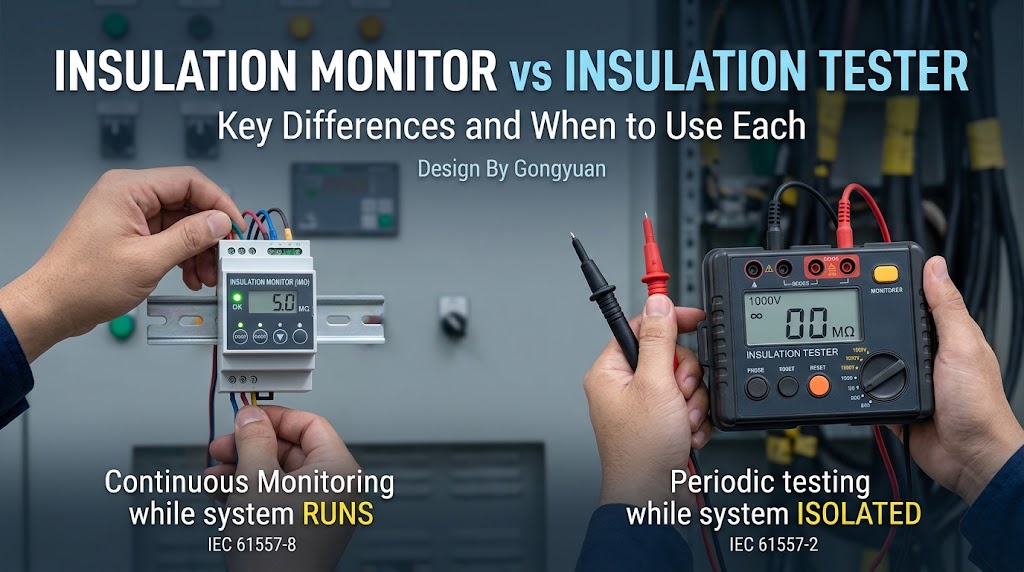
An insulation monitoring system device measures insulation resistance continuously while a system is running and raises an alarm when the value drops. An insulation tester measures it once while the system is switched off. In the insulation monitor vs insulation tester question most DC and AC floating systems need both because they do different jobs.
Engineers often treat the two devices as alternatives. They are not. A tester gives a verified reading on the day of the test. A monitor watches the system between tests and warns early. This guide explains how each one works and when to use each one. It also shows how to choose a monitor for your system voltage.
What Is an Insulation Tester?
An insulation tester (often called a megger) is a portable meter that applies a DC test voltage to a circuit and measures the resistance of the insulation to earth. It is used on circuits that are switched off and disconnected. The technician gets one reading at one moment in time.
Many testers offer test voltages such as 500 V and 1000 V so the technician can match the test to the system voltage. Typical uses include commissioning and yearly maintenance and fault finding after an alarm. Equipment of this kind is covered by IEC 61557 part 2.
For a worked example read our guide to PV isolation fault which shows how a PV array insulation resistance test is carried out.
What Is an Insulation Monitoring System Device (IMD)?
An insulation monitor device (IMD) is a fixed device that continuously measures the insulation resistance between the live conductors of an ungrounded system and earth. When the value falls below a set threshold it triggers an alarm or a relay output. It watches the system while the system keeps running.
This protection matters most in floating or IT supplies. In an ungrounded system the first insulation fault does not trip a breaker. The system keeps running and the fault stays hidden. A second fault can then cause a short circuit and a fire risk or electric shock. The monitor makes the first fault visible. Insulation monitoring devices for IT systems are covered by IEC 61557 part 8.
Gongyuan monitors report the value over RS485 Modbus RTU or CAN bus and switch a dry contact relay for local alarms depending on the model. Read How Does an Insulation Monitoring Device Work for the measuring principle.
Insulation Monitoring System Device vs Insulation Tester: Side by Side
| Point of comparison | Insulation monitor (IMD) | Insulation tester (megger) |
|---|---|---|
| When it measures | Continuously during operation | One moment during a test |
| System state | Energised and running | Switched off and disconnected |
| Who operates it | Fixed device installed in the system | Technician with a portable meter |
| Output | Alarm relay or Modbus or CAN data to a controller | Reading on the meter display |
| Main purpose | Early warning of insulation decay | Verification and fault location |
| Relevant standard | IEC 61557 part 8 | IEC 61557 part 2 |
| Typical use | EV chargers or energy storage or solar PV or rail | Commissioning or maintenance or fault finding |
Why a Tester Alone Is Not Enough
A tester only shows the insulation condition on the day of the test. Moisture or condensation or cable damage can appear between tests and stay hidden in an ungrounded system until a second fault occurs. A monitor closes that gap with continuous measurement.
Think of a yearly test as a photograph and a monitor as a security camera. Several methods exist to locate a fault once it is detected. They are explained in DC Ground Fault Detection Methods.
Why a Monitor Alone Is Not Enough
A monitor tells you that insulation is falling but it does not always tell you where the fault is. After an alarm technicians still use a tester or a locating method to find the damaged cable or module. Multi branch monitors narrow the search.
The Gongyuan multi branch DC insulation monitor watches up to 30 separate channels so the affected branch is easier to find. The technician then confirms the exact fault with a tester on the isolated section.
When to Use Each One
Use a tester for commissioning and periodic checks. Use a monitor wherever an ungrounded DC or AC system must keep running safely. Use both on EV chargers and energy storage and solar PV because the monitor warns early and the tester locates the fault.
- Commissioning: test the wiring with a tester before energising. Then check that the monitor reads a healthy value and that its alarm works.
- Daily operation: the monitor watches the system.
- After an alarm: isolate the section and use a tester or a locating method to find the fault.
- Yearly maintenance: test with a tester and confirm that the monitor alarm still works.
Related guides: insulation monitoring for EV chargers and insulation monitoring for 1500 V battery energy storage and PV isolation faults.
How to Choose an Insulation Monitor by Voltage
Choose by system voltage first. Then choose by the number of circuits and by the communication your controller uses.
- 100~1000V DC: see the 100~1000V DC insulation monitors such as the TUV and CE certified DC insulation monitor for 100~1000VDC systems with a measuring range up to 10 MΩ and RS485 Modbus RTU.
- 100~2000V DC: the UBCW2K 2000V DC insulation monitor offers a module self test and a dry contact relay alarm output. More models are listed in the 100~2000V category.
- 1000~4000V DC: the UBCW4K 4000V DC insulation monitor covers heavy industrial systems with a measuring range up to 50 MΩ. See the 1000~4000V category.
- Many feeders or battery clusters: use the multi branch monitor described above.
- AC and DC systems: the GYID insulation monitor covers 0~1000VDC and 0~750VAC floating systems with CAN bus communication. In AC systems it reports the overall insulation status and does not identify which phase is faulty.
Browse the full Product Center or check the Certifications page for TUV and CE documents.
Common Mistakes to Avoid
- Using a megger on an energised system. This is unsafe and can damage the instrument.
- Treating a monitor as a replacement for periodic testing. The two devices answer different questions.
- Setting the alarm threshold without checking the system voltage. Use the manufacturer data and the standard that applies to your installation.
- Forgetting the monitor during a high voltage insulation test. Follow the monitor manual about disconnecting it before such a test.
Frequently Asked Questions
Can an insulation tester replace an insulation monitoring device?
No. A tester gives a reading only while someone is testing and only on a system that is switched off. It cannot warn you about a fault that appears while the system runs. An ungrounded system that must stay in service needs a monitor for continuous protection.
Can I use a megger on a live system?
No. A megger applies its own test voltage and must be used only on circuits that are switched off and isolated. Connecting it to a live system is unsafe and can damage the instrument. Use a fixed insulation monitor for measurement while the system is running.
What is the difference between an IMD and an RCD?
An IMD watches insulation resistance in an ungrounded system and warns before a fault becomes dangerous. An RCD trips when leakage current flows in an earthed system. They protect different system types. Our guide IMD vs RCD explains when to use each one.
How often should insulation be tested?
Test intervals depend on local regulations and the maintenance plan of the owner. Many sites test once a year and after any alarm or repair. Always follow the standard and the rules that apply to your installation. A monitor does not remove the need for these periodic tests.
Which standards cover insulation testers and insulation monitors?
IEC 61557 part 2 covers insulation resistance measuring equipment. IEC 61557 part 8 covers insulation monitoring devices for IT systems. Product and installation rules also depend on the application such as EV charging or solar PV. Check the standards that apply in your market.
Conclusion
An insulation tester and an insulation monitor answer different questions. The tester confirms the condition today. The monitor protects the system every hour in between. For EV charging and energy storage and solar PV and rail systems the safest approach uses both.
Send your system voltage and application and communication protocol to our engineers through the contact page. They will reply with a recommended model and datasheet and certificates.
For more background, see the insulation monitoring device article on Wikipedia.