


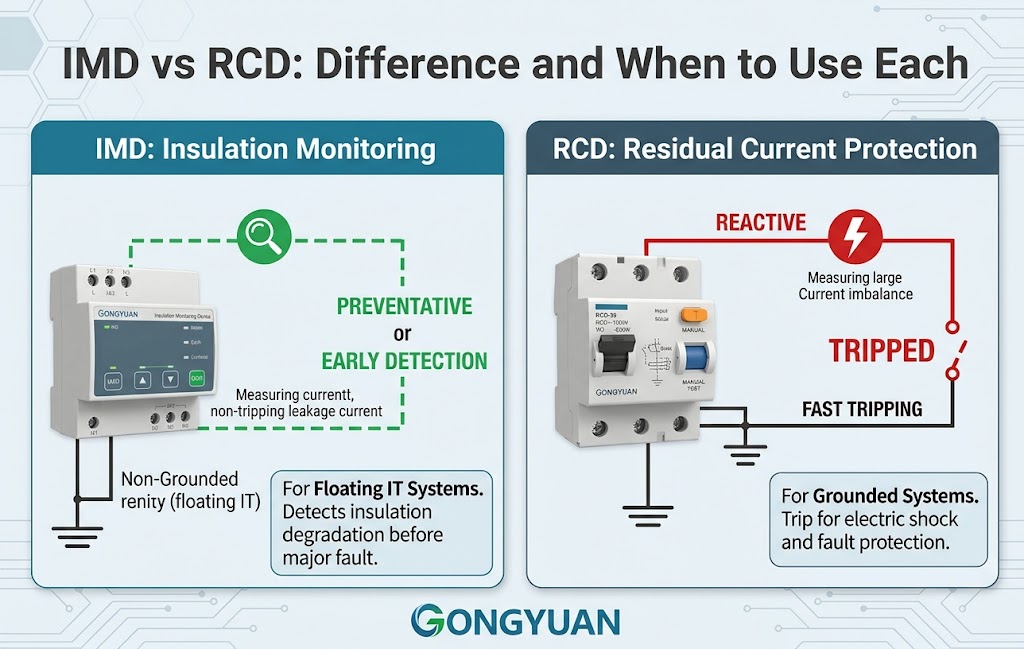
IMD vs RCD is a common question among electrical engineers designing EV charging systems, battery energy storage systems, industrial DC networks, and other critical electrical applications. Both devices are designed to improve electrical safety, but they solve different protection challenges. Choosing the wrong device can result in missed faults, unnecessary shutdowns, or reduced system reliability.
An Insulation Monitoring Device (IMD) continuously monitors insulation resistance between live conductors and earth in unearthed or floating IT systems. It detects insulation degradation before a dangerous fault develops. A Residual Current Device (RCD), on the other hand, monitors leakage current in grounded electrical systems and disconnects the circuit when current imbalance exceeds a safe limit.
The key difference is that an IMD focuses on the condition of insulation, while an RCD focuses on current leakage after a fault path exists. IMDs are commonly used in applications where system continuity is important, such as EV charging infrastructure, battery storage systems, railway networks, and industrial DC distribution. RCDs are widely used in residential, commercial, and industrial AC installations where rapid disconnection is required for protection.
Understanding the difference between these two protection methods helps engineers select the correct solution based on system grounding, voltage level, operational requirements, and safety objectives.
IMD vs RCD: Understanding the Core Difference
The main difference between an IMD vs RCD is the parameter each device measures.
An Insulation Monitoring Device measures insulation resistance between an electrical system and earth. It identifies insulation deterioration before a significant leakage current develops. This makes IMDs especially valuable in floating IT systems where the first insulation fault may not immediately interrupt operation.
A Residual Current Device measures residual current, which occurs when electrical current flows through an unintended path, usually to earth. When the difference between incoming and outgoing current exceeds a defined threshold, the RCD disconnects the circuit.
In simple terms:
- IMD = Detects insulation problems before major leakage occurs
- RCD = Detects leakage current and disconnects power
Both devices improve safety, but they are designed for different electrical system architectures.
What Is an Insulation Monitoring Device (IMD)?
An Insulation Monitoring Device (IMD) is a protection and monitoring device that continuously checks the insulation resistance of an electrical system against earth.
Unlike traditional protection devices that react after a fault occurs, an IMD provides early detection by identifying insulation deterioration before it becomes a serious electrical problem.
In floating IT systems, the active conductors are not directly connected to earth. Because there is no permanent earth reference, a single insulation fault does not necessarily create a high fault current. The system may continue operating, but the insulation condition has become unsafe.
An IMD identifies this first insulation fault and provides:
- Early warning alarms
- Continuous insulation monitoring
- Fault location assistance
- Improved system reliability
This approach is important in systems where unexpected shutdowns can create operational problems.
Common applications include:
- EV charging infrastructure
- Battery Energy Storage Systems (BESS)
- Solar DC systems
- Railway power systems
- Industrial DC networks
- Medical IT systems
For engineers working with high-voltage DC applications, IMDs provide visibility into insulation health before failures affect equipment operation.
How Does an IMD Work in an IT System?
An IT system is an electrical system where the power supply is isolated from earth or connected through a high impedance path.
Because the system is not directly grounded, the first insulation fault does not usually cause immediate disconnection.
An IMD works by applying a small measuring signal between the electrical system and earth. It then calculates the insulation resistance value.
If insulation resistance decreases below a configured threshold, the IMD generates an alarm.
The monitoring process includes:
- Measuring insulation resistance continuously
- Comparing measured values against safety limits
- Detecting insulation degradation
- Alerting operators about potential faults
For example, in an EV charging station, damaged cable insulation may gradually reduce insulation resistance. An IMD can identify this condition before it creates a dangerous situation.
This early detection capability is one of the main reasons IMDs are preferred in critical DC applications.
What Is a Residual Current Device (RCD)?
A Residual Current Device (RCD) is a protective device designed to detect current leakage and disconnect electrical circuits when abnormal current flow occurs.
In a normal electrical circuit, the current flowing through the live conductor should return through the neutral conductor. An RCD continuously compares these currents.
If some current flows through another path, such as:
- Human contact
- Damaged insulation
- Faulty equipment
- Earth leakage
the RCD detects the imbalance and trips the circuit.
RCDs are widely used because they provide fast protection against electric shock and electrical hazards.
Common applications include:
- Residential electrical systems
- Commercial buildings
- Industrial AC distribution
- Consumer electrical equipment
Unlike an IMD, an RCD requires leakage current to occur before it responds.
IMD vs RCD: Key Differences Explained
| Feature | IMD | RCD |
| Full name | Insulation Monitoring Device | Residual Current Device |
| Main measurement | Insulation resistance | Residual current |
| System type | Floating IT systems | Grounded electrical systems |
| Fault detection | Insulation degradation | Current leakage |
| Fault stage | Before major leakage develops | After leakage occurs |
| Main purpose | Early warning and monitoring | Circuit protection and disconnection |
| Common applications | EV, BESS, industrial DC | Buildings and AC systems |
| System continuity | Maintains operation after first fault | Usually disconnects circuit |
The biggest difference is timing.
An IMD identifies a potential insulation problem before it becomes a major electrical event.
An RCD reacts when current leakage has already developed.
Why IMDs Are Important in Floating DC Systems
Floating DC systems create unique protection challenges because the first insulation fault may not immediately create enough current to activate conventional protection devices.
Examples include:
- Battery storage systems
- EV charging systems
- Solar DC systems
- Industrial DC distribution
In these applications, unexpected shutdowns can affect:
- Production operations
- Energy availability
- Charging infrastructure
- Equipment performance
An IMD provides continuous monitoring so engineers can identify insulation issues early.
For example, a battery storage system operating at high DC voltage may continue functioning after a first insulation fault. However, if a second fault occurs, dangerous current paths can develop.
By detecting the first fault, an IMD allows maintenance teams to investigate and repair issues before they become critical.
Why RCDs Are Important in Grounded Systems
Grounded electrical systems are designed differently from floating systems.
In these systems, leakage current can flow through earth when insulation fails. An RCD detects this current imbalance and disconnects the circuit.
RCD protection is valuable because it helps prevent:
- Electrical shock hazards
- Fire risks
- Equipment damage
For example, if a damaged appliance allows current to flow through a person to earth, an RCD can quickly disconnect the power supply.
This makes RCDs an essential safety component in many low-voltage electrical installations.
Can an IMD Replace an RCD?
No. An IMD cannot replace an RCD because both devices provide different types of protection.
An IMD monitors insulation resistance and identifies insulation deterioration.
An RCD detects leakage current and disconnects power when unsafe current flow occurs.
They are designed for different system conditions.
Replacing an RCD with an IMD in a grounded system may not provide the required protection.
Similarly, using only an RCD in a floating DC system may not provide early insulation fault detection.
Engineers must select protection based on:
- System grounding method
- Voltage type
- Application requirements
- Safety standards
Can IMD and RCD Be Used Together?
Yes, in some systems, IMDs and RCDs can complement each other.
A combined protection strategy may include:
- IMD for continuous insulation monitoring
- RCD for leakage current protection
For example, a complex electrical installation may require insulation monitoring during normal operation and additional residual current protection for specific circuits.
The correct approach depends on the system design and applicable requirements.
IMD vs RCD Applications Comparison
EV Charging Systems
EV charging infrastructure often uses DC systems where insulation monitoring is important.
Charging equipment must detect insulation problems because:
- High DC voltage increases safety risks
- Cable damage can reduce insulation quality
- Continuous operation is required
IMDs help monitor insulation conditions and provide early fault warnings.
Battery Energy Storage Systems
Battery systems operate at high DC voltages and require reliable fault monitoring.
IMDs help identify:
- Battery insulation degradation
- Cable insulation issues
- DC system faults
Early detection reduces downtime and improves maintenance planning.
Industrial DC Networks
Industrial facilities often depend on continuous power availability.
A sudden shutdown can impact:
- Manufacturing processes
- Automation systems
- Production schedules
IMDs allow operators to identify insulation problems without immediately stopping operation.
Buildings and Commercial Electrical Systems
Buildings typically use grounded AC systems where RCD protection is common.
Applications include:
- Electrical outlets
- Equipment circuits
- Consumer installations
RCDs provide fast protection against leakage current hazards.
How to Choose Between IMD and RCD
Choosing between an IMD and RCD depends on the electrical system design.
Choose an IMD When:
- The system is an unearthed IT system
- Continuous operation is important
- Early insulation fault detection is required
- The application involves DC voltage
- Downtime must be minimized
Examples:
- EV chargers
- BESS
- Railway systems
- Industrial DC networks
Choose an RCD When:
- The system is grounded
- Leakage current protection is required
- Fast circuit disconnection is needed
Examples:
- Buildings
- AC distribution systems
- Electrical equipment protection
IEC 61557-8 and Insulation Monitoring Devices
IEC 61557-8 is an international standard related to insulation monitoring devices used in low-voltage distribution systems.
The standard defines requirements related to:
- Measurement principles
- Device performance
- Safety requirements
- Insulation monitoring functions
Engineers often refer to IEC 61557-8 when evaluating IMD solutions for electrical installations.
When selecting an insulation monitoring solution, technical teams should review:
- System voltage range
- Application requirements
- Communication requirements
- Applicable standards
Common Mistakes Engineers Make When Selecting Protection Devices
Using RCD Protection Where Insulation Monitoring Is Required
One common mistake is assuming leakage protection can replace insulation monitoring.
In floating DC systems, the first insulation fault may not create enough leakage current for an RCD to respond.
Ignoring First Fault Detection
Many critical systems require early warnings instead of immediate shutdowns.
IMDs provide visibility into insulation conditions before failures occur.
Selecting Devices Without Considering Voltage Requirements
Different applications require different monitoring capabilities.
Engineers should consider:
- Operating voltage
- DC or AC system type
- Grounding method
- Communication needs
Gongyuan Experience With Insulation Monitoring Applications
Through experience with insulation monitoring applications, engineers working on industrial DC systems often face similar challenges: maintaining safety while avoiding unnecessary downtime.
In applications such as EV charging and energy storage, insulation conditions can change because of environmental factors, cable aging, and equipment stress.
Continuous insulation monitoring helps operators identify abnormal conditions earlier and plan maintenance before faults affect system performance.
A practical protection strategy requires understanding the complete electrical system rather than selecting devices based only on voltage ratings.
Frequently Asked Questions About IMD vs RCD
What is the difference between IMD and RCD?
An IMD measures insulation resistance between the electrical system and earth, while an RCD detects leakage current and disconnects power when current imbalance occurs.
Can an IMD replace an RCD?
No. IMDs and RCDs provide different protection functions. IMDs monitor insulation conditions, while RCDs provide leakage current protection.
Where are insulation monitoring devices used?
IMDs are commonly used in EV charging systems, battery energy storage systems, industrial DC networks, railway systems, and other floating IT applications.
Why are IMDs used in EV charging systems?
IMDs help detect insulation faults in high-voltage DC charging systems before they become dangerous or cause equipment failures.
What standard applies to insulation monitoring devices?
IEC 61557-8 is a commonly referenced standard for insulation monitoring devices used in electrical installations.
Are IMDs only used for DC systems?
No. IMDs can be used in different IT system applications, including both AC and DC systems, depending on the electrical design.
Conclusion
Understanding IMD vs RCD is essential for engineers designing safe and reliable electrical systems. While both devices improve electrical protection, they operate in fundamentally different ways.
An IMD continuously monitors insulation resistance and provides early fault detection in floating systems. An RCD detects leakage current and disconnects power in grounded systems.
For applications such as EV charging, BESS, and industrial DC networks, insulation monitoring provides valuable visibility into system health and helps prevent unexpected failures.
Selecting the correct protection device depends on understanding the electrical architecture, operating requirements, and safety objectives of the application.