


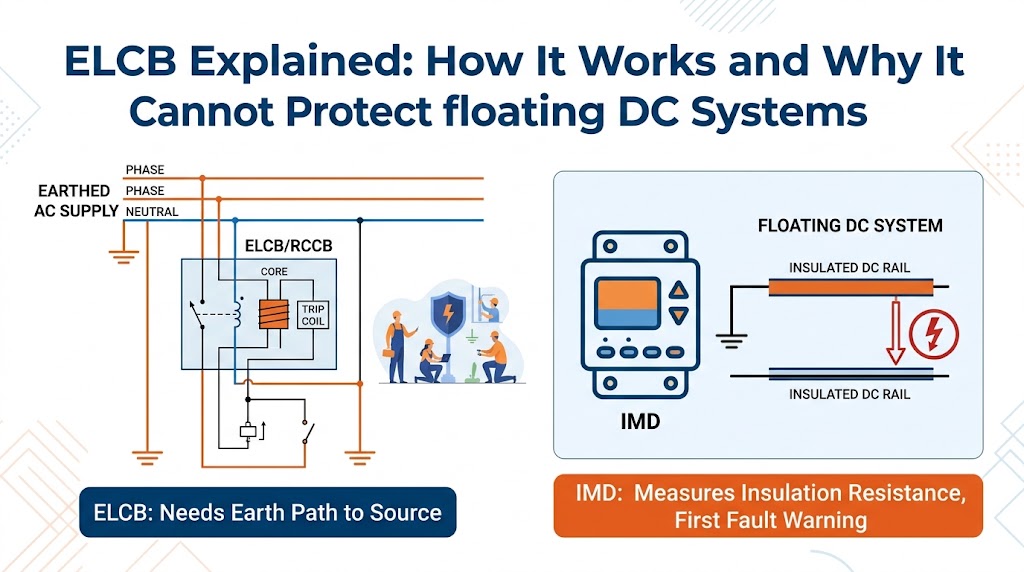
Short answer: an ELCB (earth leakage circuit breaker) is a safety device that disconnects a circuit when current leaks to earth. It protects people from electric shock on earthed AC systems. It does not protect floating or DC systems because no leakage path returns to the device. Those systems need an insulation monitoring device (IMD).
Most online guides stop at the basics of ELCB working and types. This guide covers those basics and then goes further. It explains where an ELCB stops working and what to use instead in EV charging and battery storage and solar PV and other ungrounded systems.
What Is an ELCB?
An ELCB is a protective device that detects earth leakage and switches the circuit off before the leakage causes electric shock or a fire. It sits at the start of a circuit and watches for current that escapes to earth through a fault or through a person.
ELCBs are used in homes and shops and factories on AC supplies where the neutral is earthed. Small leakage currents through the body can cause serious harm so the device must act quickly.
ELCB Full Form and Why the Name Causes Confusion
ELCB stands for earth leakage circuit breaker. The name has two meanings in practice. The older meaning is a voltage operated device that watches the voltage on the metal body of equipment. The modern meaning in everyday speech is a current operated device that is also called an RCD or an RCCB. Many electricians and shops now use the word ELCB for both.
Current operated devices are covered by IEC 61008 for RCCBs and IEC 61009 for RCBOs. Always check which type a product really is before you buy or specify it.
How Does an ELCB Work?
A current operated ELCB compares the current in the phase conductor with the current in the neutral conductor. The two are equal when the circuit is healthy. If some current leaks to earth the two values differ and the device trips within a fraction of a second.
Both conductors pass through a ring shaped sensing core. Equal currents cancel each other magnetically. A leakage leaves a small net magnetic field that drives a trip coil and opens the contacts.
A voltage operated ELCB works differently. A coil connects the metal frame of the equipment to a separate earth electrode. If the frame becomes live a voltage appears across the coil and the breaker trips. This design depends on a good earth electrode and protects only the connected equipment. It has largely been replaced by current operated devices.
Types of ELCB: Voltage Operated and Current Operated
| Feature | Voltage operated ELCB | Current operated ELCB |
| What it detects | Voltage on the equipment frame | Imbalance between phase and neutral current |
| Sensing electrode | Needs a dedicated earth electrode | Does not depend on a sensing electrode |
| Coverage | Only the connected equipment | The whole circuit behind the device |
| Use today | Largely obsolete | Standard choice (RCD or RCCB) |
ELCB vs RCCB vs RCD vs MCB
An RCD and an RCCB are current operated devices that protect people from earth leakage. Today most people mean these when they say ELCB. An MCB protects cables from overload and short circuit and does not detect earth leakage. An RCBO combines both functions in one unit.
| Device | What it detects | Main purpose | Note |
| ELCB (old voltage type) | Frame voltage | Shock protection for one appliance | Largely obsolete |
| ELCB (current type) or RCD or RCCB | Phase and neutral imbalance | Shock and fire protection | Does not trip on overload or short circuit |
| MCB | Overload and short circuit | Cable and equipment protection | Does not detect earth leakage |
| RCBO | Leakage plus overload and short circuit | Combined protection | Covered by IEC 61009 |
For a deeper comparison of leakage protection and insulation monitoring read IMD vs RCD: What Is the Difference and When to Use Each.
What Does ELCB Sensitivity Such as 30 mA Mean?
ELCB sensitivity is the leakage current at which the device trips. A 30 mA device trips when about 30 mA leaks to earth. This rating is widely used for personal protection. Higher ratings such as 100 mA or 300 mA are used for fire protection or for larger installations.
Choose the rating from the local wiring rules and the purpose of the circuit. A lower rating gives better shock protection but may trip more often when many appliances each leak a little.
ELCB Wiring Basics
Wiring must follow local rules and be done by a qualified electrician. These principles apply to a current operated device:
- Phase and neutral both pass through the device. A two pole unit serves single phase circuits and a four pole unit serves three phase circuits with neutral.
- Connect the supply to the line terminals and the load to the load terminals. Follow the markings because some devices must not be reversed.
- Never connect the neutral after the device to the neutral of another circuit. A shared neutral causes false trips.
- Press the test button after installation.
How to Test an ELCB
Press the test button on the device. A healthy ELCB trips at once. The button creates a small artificial imbalance to check the trip mechanism. It does not prove that the earthing or the wiring is safe.
- Make sure equipment that cannot lose power is protected or switched off.
- Press the test button.
- Confirm that the lever drops to the off position.
- Reset the device.
- If it does not trip replace it and do not rely on it.
Test at the interval given by the manufacturer. Full commissioning tests need an instrument that injects a known leakage current and measures the trip time. A qualified electrician should carry this out. To check the insulation of the wiring itself read Insulation Monitor vs Insulation Tester.
Why Does an ELCB Keep Tripping?
An ELCB trips when it detects leakage to earth. The usual causes are a damaged appliance or moisture in wiring or a shared neutral or many small leakages adding up. Lightning surges and a faulty device can also cause tripping.
- An appliance with a leaking heating element such as a water heater or a washing machine
- Moisture in sockets or junction boxes or outdoor fittings
- A neutral shared with another circuit
- Damaged cable insulation
- Many appliances whose small leakages add up
- A surge or lightning strike
- A faulty ELCB
To find the cause unplug all loads and reset the device. If it holds plug the appliances in one at a time. If it trips with nothing connected suspect the wiring or the device and call an electrician.
Why an ELCB Cannot Protect Floating DC Systems
An ELCB needs a leakage path that returns current to the source through earth. In a floating or IT system the first fault creates no such path so no residual current flows. The ELCB stays closed and the fault stays hidden. DC leakage can also blind common ELCB types.
No Return Path in Floating Systems
EV chargers and battery storage and solar PV strings and many industrial DC networks are intentionally ungrounded. The first insulation fault does not create a complete loop so nothing trips. The system keeps running. A second fault at another point can then cause a short circuit and a fire risk or electric shock. An IMD measures insulation resistance continuously and warns at the first fault. Read How Does an Insulation Monitoring Device Work for the measuring principle.
DC Residual Current and RCD Types
Standard AC type devices respond to alternating residual current. Type A devices also detect pulsating DC. Type B devices detect smooth DC residual current. Smooth DC leakage can reduce the sensitivity of AC and Type A devices. This is why EV charging designs need DC fault protection such as a Type B device or a DC detecting module in addition to insulation monitoring. Check the rules that apply in your market.
Where This Matters Most
- EV chargers: read Insulation Monitoring Device for EV Chargers. The GYDCG UBCH1 multifunctional DC insulation monitor is built for EV charging piles.
- Battery energy storage: read Insulation Monitoring for Battery Energy Storage Systems.
- Solar PV: read PV Isolation Fault. The UBCW2K 2000V DC insulation monitor suits PV and storage systems up to 2000 Vdc.
- Locating a fault after the alarm: read DC Ground Fault Detection Methods.
ELCB vs IMD: Which One Do You Need?
Use an ELCB where an earthed AC supply needs shock protection. Use an IMD where the system is floating or DC and must keep running. Many installations use both in different parts of the system.
| Point of comparison | ELCB (current operated) | IMD |
| System type | Earthed AC | Floating (IT) AC or DC |
| What it measures | Residual current to earth | Insulation resistance to earth |
| When it responds | After leakage current flows | As insulation degrades and at the first fault |
| Action | Disconnects the circuit | Raises an alarm or relay signal |
| Typical use | Homes and buildings and sockets | EV chargers and energy storage and solar PV and rail |
| Standard | IEC 61008 or IEC 61009 | IEC 61557 part 8 |
Choose an IMD by system voltage. See the 100~1000V DC insulation monitors or the 1000~4000V DC insulation monitors. For floating AC systems up to 750 Vac see the GYID insulation monitor. Browse the full Product Center or check the Certifications page for TUV and CE documents.
Frequently Asked Questions
What is the full form of ELCB?
ELCB stands for earth leakage circuit breaker. It is a device that disconnects a circuit when current leaks to earth. The term is used for an older voltage operated design and for the modern current operated device that is also called an RCD or an RCCB.
What is the difference between ELCB and RCCB?
In modern use there is little difference because most ELCBs sold today are current operated devices and are RCCBs. The older voltage operated ELCB is a different design that depends on an earth electrode. It is now rare and offers limited protection.
Does an ELCB work on DC systems?
Not reliably. A basic ELCB cannot detect leakage in a floating DC system and smooth DC residual current can reduce its sensitivity. Use an insulation monitoring device and where required a Type B device or a DC detecting module.
Why does an ELCB not trip in an IT system?
An IT system has no direct connection between live conductors and earth. The first insulation fault creates no return path so no residual current flows through the device. The ELCB stays closed while the fault stays hidden. An insulation monitoring device is used to detect it.
Can an ELCB replace an insulation monitoring device?
No. An ELCB disconnects after leakage current flows in an earthed AC system. An IMD gives early warning in floating systems before a second fault. They protect different system types. Our guide IMD vs RCD explains when to use each one.
What does the ELCB test button check?
The test button creates a small artificial imbalance and checks that the device trips. It does not check the earth connection or the condition of the wiring. Press it at the interval given by the manufacturer and use proper instruments for full tests.
Conclusion
An ELCB is the right tool for shock protection on earthed AC circuits. It is the wrong tool for floating and DC systems such as EV chargers and battery storage and solar PV. In those systems an insulation monitoring device gives the early warning that an ELCB cannot give.
Send your system voltage and application and communication protocol to our engineers through the contact page. They will reply with a recommended model and datasheet and certificates.
For a concise overview of how a Residual current device operates, see the Wikipedia article on the Residual current device.